Is It Breakage or Shedding? Fix in Days
Not sure if you are seeing breakage, normal shedding, or early hair loss? This beginner-friendly guide shows the fastest ways to tell the difference, what a normal daily shed looks like, and a simple 7 day rescue plan with low-tension hairstyles and clear signs it is time to see a dermatologist.
Hair in your brush can feel alarming, but not every strand means you are losing hair. Breakage, normal shedding, and true hair loss often look the same at first, which makes it easy to treat the wrong problem and waste weeks. In this guide, you will learn quick signs that separate shedding from breakage, the beginner mistakes that quietly make strands weaker, and a simple plan you can start today. Expect clearer answers, calmer decisions, and stronger-feeling hair within days.
Breakage vs shedding: the fastest at home tests

Here is the simplest way to think about what you are seeing: shedding is hair that finished its natural cycle and released from the follicle, breakage is hair that snapped somewhere along the strand, and hair loss is when you are gradually getting less hair density because shedding is not being replaced (or follicles are shrinking). A quotable rule: shedding is a “letting go” from the scalp, breakage is “splitting or snapping” from damage, and hair loss is a “net decrease” you can notice in your part, temples, or overall volume. You do not need special tools to start sorting this out, just good light, clean fingers, and a calm five minutes.
Most panic starts with one common misconception: counting hair in the shower without considering wash frequency, hair length, texture, and how you style. If you wash 2 to 3 times a week, you will naturally see more hair come out on wash day because loose strands have been hanging around in your hair, especially in curls, coils, braids, or a blowout that you are trying to stretch. Long hair also looks more dramatic in a drain catcher than a short crop, even if the number of strands is identical. The “fix” is not to attack your hair with extra protein, harsh clarifying, or tight protective styles. The fix is to identify which type of fall you are dealing with first.
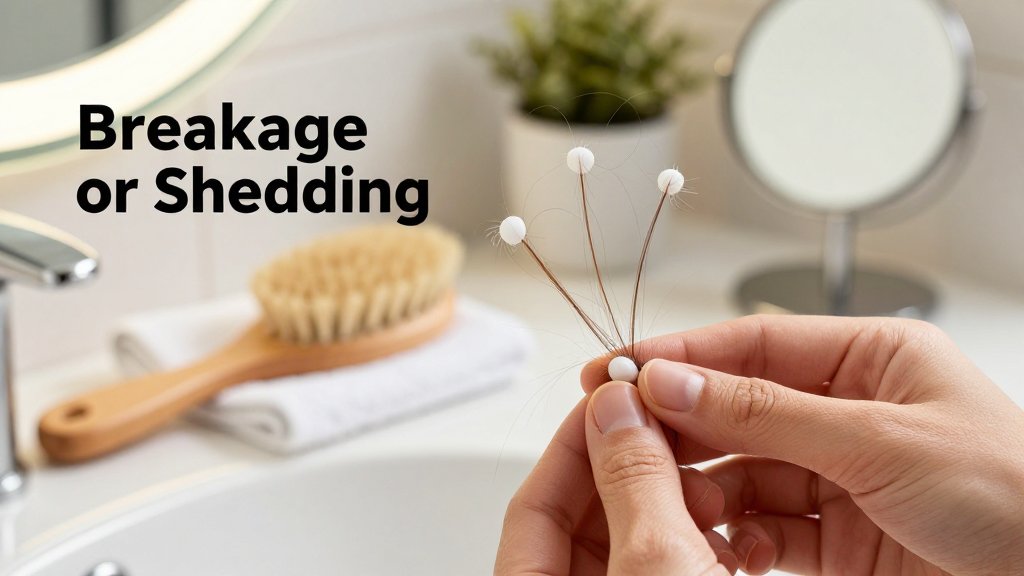
If the strands have a little white bulb, you are seeing shedding, not snapping. If they are short, rough, and different lengths, that is breakage. Count what you lose across a full week, not one shower.
The 10 second strand check: bulb, length, and texture
Pick up 3 to 5 strands from your brush, pillowcase, hoodie, or your palm after applying conditioner. Lay them across your fingers and look at both ends. A shed strand often has a tiny white or pale bulb on one end, and the rest of the hair looks like a full-length “finished” strand. Breakage usually has no bulb, and the ends look blunt (like a clean snap) or frayed (like a little paintbrush). Now do the feel test: shed hairs feel like normal hair from root to tip, while broken hairs feel shorter, rougher, and uneven in thickness. Breakage also tends to cluster around the crown, hairline, and ends, where heat and friction hit most.
Use your styling habits as clues. If you have been flat-ironing the same face-framing pieces, touching up curtain bangs daily, or wearing a tight slick ponytail for workouts, the weakest points are predictable. Brides often see breakage right at veil or pin placement, plus along the nape from backcombing and hairspray buildup. Color changes can do it too: going from espresso brunette to platinum, then “toning every two weeks” can leave the mid-lengths and ends fragile, even if your scalp feels fine. On the flip side, shedding can look scary but be evenly distributed, meaning you see similar strands all over, not just one “problem zone.” If your short pieces are concentrated at the temples and hairline, consider friction from hats, helmet straps, bonnets, or rough towel-drying.
What is normal shedding per day, and when it is not
A beginner-friendly baseline helps a lot: many people shed about 50 to 100 hairs per day, and some days look heavier than others. The American Academy of Dermatology states it is normal to shed 50 to 100 hairs daily in their hair shedding overview. If you wash only a couple times a week, it may look like “more than normal” in the shower because multiple days of shed strands release at once. Curly, coily, and textured hair can hold onto those loose hairs until wash day, so the count you see is not the count you shed that exact day. If you want a fair comparison, track what you see across 7 days, not one rinse.
Shedding is more likely “not normal for you” if your baseline suddenly jumps and stays elevated for several weeks, or if you notice true density changes. Quick, no-tool signs include: your part looks wider in photos, your ponytail feels thinner when you wrap a hair tie, you can see more scalp at the crown under bathroom lighting, or you notice patchy spots (not just flyaways). Also check your edges: breakage can mimic thinning at the temples, especially if you do gelled styles, tight braids, or frequent edge brushing. If you are in a postpartum season and also dealing with short regrowth hairs, you can borrow instant confidence from postpartum regrowth hiding styles while you figure out whether you are seeing shedding, breakage, or both.
Once you name what is happening, you can stop overtreating. For breakage, think “less friction, less heat, more slip”: swap to a silk or satin pillowcase, detangle with conditioner before shampooing, and retire tight elastics in favor of a soft scrunchie or claw clip. For shedding, focus on gentle consistency rather than aggressive routines, since your goal is to keep the scalp comfortable and the strands from tangling while they naturally cycle. If you are trying new looks while you recover, choose styles that visually thicken hair without tension, like a textured lob, a layered shag, a curly bob, or a side part with soft face-framing. The best test is repeatable: do the strand check twice a week in the same lighting, and let the pattern tell you what to do next.
Why hair breaks: the usual hidden causes
If you are seeing short pieces in the sink, little flyaways that will not “lay down,” and ends that look uneven no matter how carefully you trim, treat it like fabric damage. Hair is a fiber, and breakage is usually a pattern problem, not a medical mystery. The strand is snapping somewhere along the length, so you end up with a mix of long hairs plus tiny, stubborn fragments that make your style look frizzy or thin in patches. The fix is less about “more growth” and more about stopping whatever is weakening the strand day after day, then reducing friction so the weak points stop tearing.
Breakage also tends to show up right after a routine change: a new highlight appointment, a month of daily hot tools, a protective style that stayed in a little too long, or even a new detangling brush you are using aggressively. The encouraging part is that once you identify the trigger, you can often feel improvement quickly because you are preventing new snaps immediately. For a reality check, the American Academy of Dermatology’s hair damage tips line up with what most stylists see in the chair: lower heat, gentler handling, and fewer harsh chemical hits. (aad.org)
The big four: heat, bleach, tension, and friction
Heat is the most common “I did not realize it counted” culprit. A real life example: flat ironing above 350 F, more than once a week, with multiple slow passes per section. Add a hot brush on non-wash days and you have repeated dehydration plus surface cracking, especially on fine hair and on curl patterns that already have natural weak points. Another sneaky one is blow-drying with the nozzle off, then “finishing” with the iron because the hair still feels puffy. If you want fast damage control, pick one tool per day, keep the temperature as low as your hair will actually set at, and stop reheating the same strands just to chase perfection. (aad.org)
Bleach and high-lift color can break hair in a different way, they make the strand weaker even before you touch it. A classic pattern is breakage concentrated around the highlight line, the face-framing pieces, or the crown where lightener processed a bit longer. If you lighten (or even repeatedly tone) without bond support, the strand can lose resilience and snap during brushing. Tension and friction finish the job: tight ponytails, sleek buns, braids that pull at the hairline, or extensions that feel “snug” can create stress points that break exactly where the elastic sits. Then friction from cotton pillowcases, rough towel drying, and aggressive detangling turns small weaknesses into split ends that climb. One counterintuitive twist: hair can feel dry but actually be stiff from too much protein or “repair” layering, which can make it snap instead of stretch. (healthline.com)
Fast habit fixes that show up in days
Start with the swaps that reduce stress on contact. Rinse in lukewarm water instead of very hot, because overly hot rinses can leave hair feeling rough and harder to detangle. Detangle only when the hair has “slip,” meaning conditioner is on and your fingers can glide from mid-length to ends before you ever touch a brush. Use a wide-tooth comb or a flexible detangling brush, begin at the ends, and work upward in small sections. For drying, squeeze water out with a microfiber towel or a clean cotton tee, then blot. Rubbing is basically sandpaper on fragile cuticles. Keep daily styles low-tension for a week: loose claw clip twists, a soft scrunchie ponytail, or a braid that you can slide a finger under at the base.
Then support the strand with a simple product lineup, by category, so you are not guessing. Use a gentle shampoo that cleans without leaving your hair squeaky, especially if you are color-treated. Follow with a rich conditioner that gives slip and softness, then add a leave-in on damp hair to reduce combing friction. If you heat style at all, treat heat protectant as non-negotiable, even for a quick blowout bang moment. Finish with a lightweight oil or silicone serum only on the last 2 inches of hair (think ends and any highlighted pieces) to reduce snagging on clothes and pillowcases. If your hair feels stiff and snaps, pause heavy protein masks for two weeks and lean into moisture-focused conditioners instead. (healthline.com)
A simple timeline helps you stay motivated because breakage repair is mostly prevention. You can often notice less snapping in 3 to 7 days, especially if you stop dry detangling and reduce heat passes. A smoother feel typically shows up in 1 to 2 weeks once the cuticle is not being roughed up daily and your ends are lubricated consistently. Visible length retention usually takes 4 to 8 weeks, because you are comparing “how much hair stayed on your head” over multiple wash cycles, not overnight growth. Track it like a stylist would: take the same-angle photo of your ends weekly, note how much short fuzz shows up around your part, and pay attention to whether your ponytail elastic is collecting little broken hairs. If you want a confidence boost while you baby your hair, try low-tension styles in Fravyn (like a soft layered lob, loose waves, or a side-part blowout) so you can change your look without punishing your ends.
Fix in days: a 7 day plan plus when to get help
Your fastest win in the next week is reducing tension and friction, because that can stop breakage right away, even before new growth shows up. For the next 7 days, treat hair like delicate fabric: detangle only when it is damp and slippery with conditioner, start from the ends, and use a wide-tooth comb or a flexible detangling brush. Swap cotton pillowcases for satin or silk, and use a satin bonnet or scarf if you toss at night. If you heat style, cap it at 1 to 2 passes per section with a heat protectant, and skip tight elastics completely.
Here is a realistic 7-day rescue plan that focuses on calmer styling, scalp basics, and fewer mechanical stressors (the stuff that makes strands snap): - Day 1: Remove tension. Wear hair down or in a loose low pony with a satin scrunchie, then gently detangle. - Day 2: Cleanse the scalp. Shampoo mainly at roots, condition mids to ends, and rinse thoroughly. - Day 3: Add slip and strength. Do a 5 to 10 minute mask; choose moisture if hair feels crunchy, protein if it feels gummy. - Day 4: Scalp reset. If you have flakes or itch, use an anti-dandruff shampoo and let it sit 3 to 5 minutes. - Day 5: Micro-trim plan. Book a dusting, or trim only obvious split ends. - Day 6: Protective style day. Pick a low-tension style that stays put without pulling. - Day 7: Recheck. Compare photos, part width, and your brush shed, then decide if it is improving.
Low-tension styling that protects and hides thinning
Match the style to the weak spot. For breakage at the hairline, try a loose side part, a soft claw-clip twist (clip anchored at the back, not gripping baby hairs), or a satin scrunchie pony placed low on the head so edges are not strained. For crown breakage, go for a half-up with loose tension secured with mini clips, or a low bun with ends tucked and pinned gently, because it protects fragile crown pieces from rubbing. For thinning, a texturized bob or lob, curtain bangs, and root-lift styling (mousse at roots, blow-dry upward with a round brush) can disguise see-through areas. Strategic color placement helps too: subtle highlights or a soft root shadow can reduce scalp-to-hair contrast. Protective options include loose braids, flat twists with minimal tension, and wigs secured with a grip band instead of glue when possible.
Scalp basics matter because irritated skin sheds more and feels tender when you style. Wash often enough that your scalp feels clean, not squeaky, and focus shampoo on the roots with your fingertips (not nails). If you use dry shampoo, do not stack it for days, because buildup can make shedding look worse when you finally wash. Keep your styling tools gentle too: a microfiber towel or cotton T-shirt for blotting, a heat protectant before hot tools, and a low-heat setting whenever you can. If you are planning a big event look, like bridal waves or a sleek bun, test your style in advance and choose pins and accessories that do not snag. Apps like Fravyn can help you preview a texturized lob, curtain bangs, or a softer side part on your own photo before you commit. > If you can see more scalp than usual, or you notice a widening part that keeps expanding over a few weeks, do not just switch shampoos. Take photos, track shedding, and get a professional exam.
Now the “when to get help” line. Most people shed some hair daily, and the American Academy of Dermatology notes a normal shedding range of about 50 to 100 hairs per day. Worry less about a single shower and more about a pattern: shedding that suddenly doubles, lasts longer than 6 to 8 weeks, or comes with scalp pain, heavy itching, or visible patches. Also get help sooner if you see a rapidly widening part, a bald spot, broken hairs all over the sink plus a burning scalp, or if lashes and brows are thinning too. Those are not “wait it out” moments, they are “book the appointment” moments.
How can I tell if it is breakage or shedding if my hair is curly or coily?
Curly and coily hair can hide shed strands until wash day, so it is easy to overestimate “sudden” loss. Check the strand itself: shedding usually has a tiny white bulb on one end and the length looks normal for you, while breakage looks shorter, frayed, or snaps into multiple little pieces. Pay attention to where it is happening. More short pieces around edges and the crown often points to tension, friction, or heat damage. Lots of full-length strands after detangling can be normal, especially if you wear twist-outs, wash weekly, or finger-detangle most days.
How much hair shedding is normal, and when should I worry about hair loss?
Daily shedding varies, but a consistent, small amount is expected. What matters is change: if your ponytail feels thinner week to week, your part is widening, or you are seeing clumps repeatedly, that is a signal to look deeper. Stress, illness, major surgery, new meds, and postpartum shifts can trigger heavier shedding weeks later, and it can take months to calm down. If shedding is heavy and steady beyond about 2 months, if you see patchy loss, or if the scalp is inflamed, sore, or scaly, skip guesswork and get evaluated.
When should I see a dermatologist for hair loss, and what should I ask for?
See a dermatologist promptly if you have sudden patchy loss, scalp pain, bleeding, thick scale, or shedding that keeps ramping up instead of easing. Go in prepared: bring 3 photos (front hairline, center part, crown), list any recent stressors or illnesses from the last 3 to 4 months, and write down new medications, supplements, or rapid weight changes. Ask what pattern they see (shedding vs miniaturization), whether they recommend a hair pull test or scalp dermoscopy, and which labs make sense for your symptoms (thyroid, iron status, and other nutrition markers are common discussion points). If the diagnosis is unclear, ask when a scalp biopsy is appropriate and what improvement timeline is realistic.
Ready to see how a new hairstyle looks on you before you commit? Try Fravyn to preview 50+ styles on your own photo in seconds, so you can pick a look that complements your hair goals with confidence. Download the app here: iOS. Upload a photo, test styles, and save your favorites for your next appointment.
Try a New Hairstyle Today
Preview 50+ hairstyles and 29+ colors on your own photo with Fravyn.